After-Hours Stop Hunts and Pattern Recognition
Trading notes for 2026-03-12
By Sean WeldonTL;DR
Paired oil long with ES short on Thursday based on Wyckoff accumulation and divergence thesis. Locked +$7 on oil, got stop hunted at break even on ES before the real move happened after hours. Pattern recognition working, timing needs refinement.
Market Context
Thursday morning opened with ES consolidating after Wednesday's CPI-induced chop. Oil had spiked to $119 earlier in the week on Iran tensions, then crashed back to the $88-94 range. ES was sitting just above PWL at 6,718, which had acted as support during the overnight futures session. The weekly low from Monday's gap down sat at 6,584—a key level I expected to test.
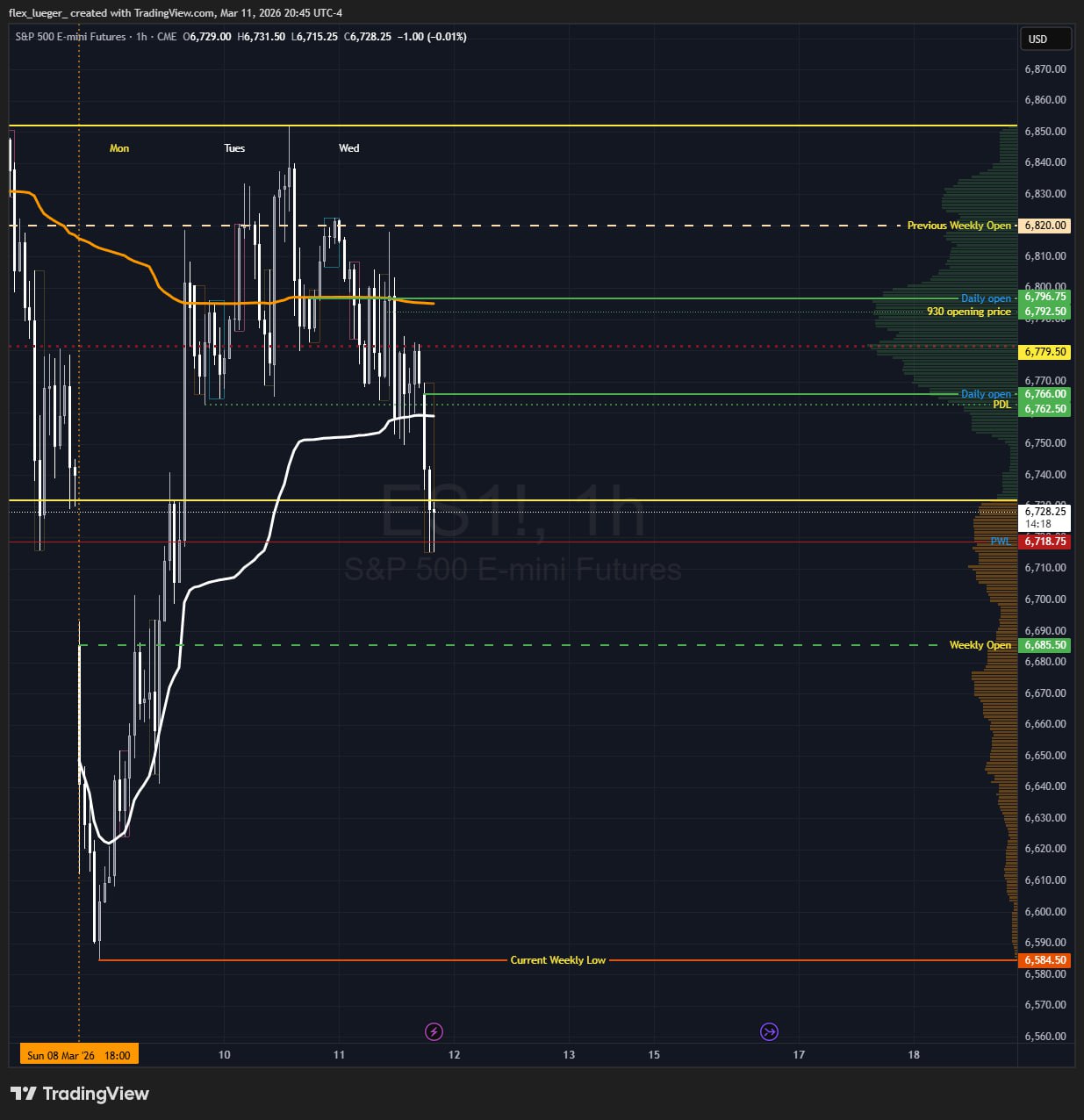
The setup was clean: oil showing textbook Wyckoff accumulation at weekly support, while ES looked weak despite the energy sector attempting to stabilize. The divergence between the two suggested institutional distribution in equities even as oil found a bottom.
Thesis & Plan
The thesis was simple: oil accumulation at support combined with ES weakness equals confirmation of Thursday range expansion to the downside. I'd been tracking a pattern where NY sessions stayed quiet, then futures/after-hours sessions made the real moves. Wednesday did exactly this—dead until 6pm ET, then pushed straight to PWL.
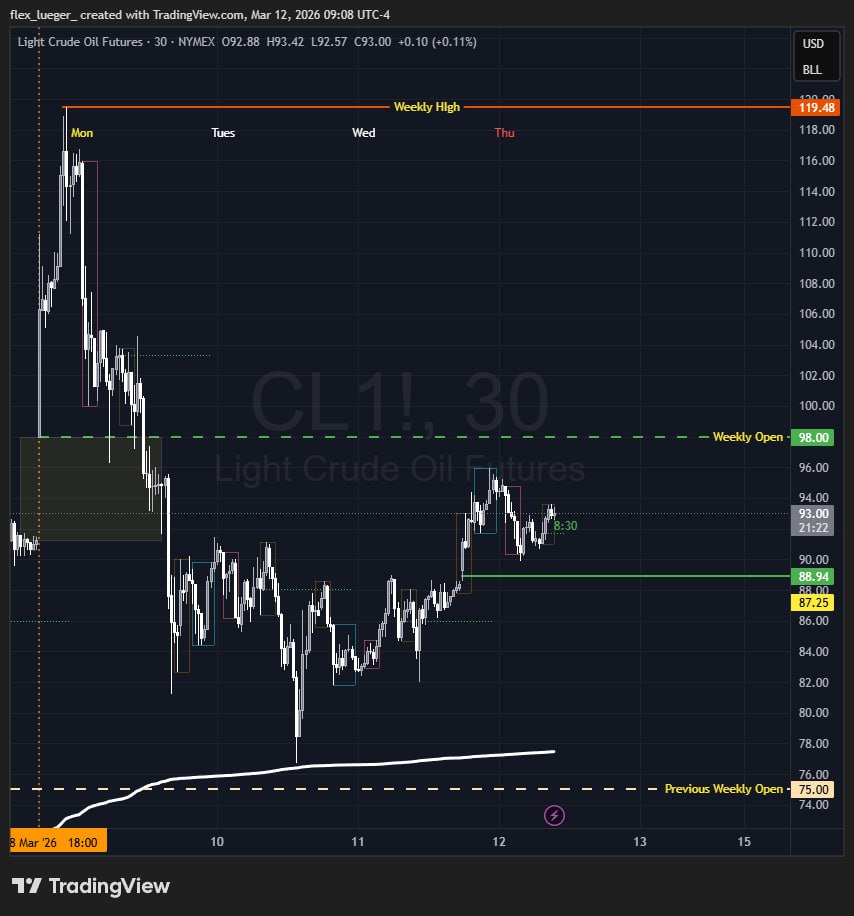
For oil, I was watching the $88.94 support level where a last point of support (LPS) was forming. Entry would be around $94 on confirmation of the spring pattern. For ES, the plan was a short targeting the weekly low at 6,584, with a stop above 6,750 to avoid getting caught in the 10:30 AM reversal window.
Position sizing: 25-50% normal size max. Challenge mode rules—halfway to profit target means no hero trades.
Entries & Exits
Entered oil long around $94 as it bounced off the support zone. The Wyckoff pattern was textbook—initial spike, distribution, then accumulation at the LPS. Entry was clean, stop below $88.90.
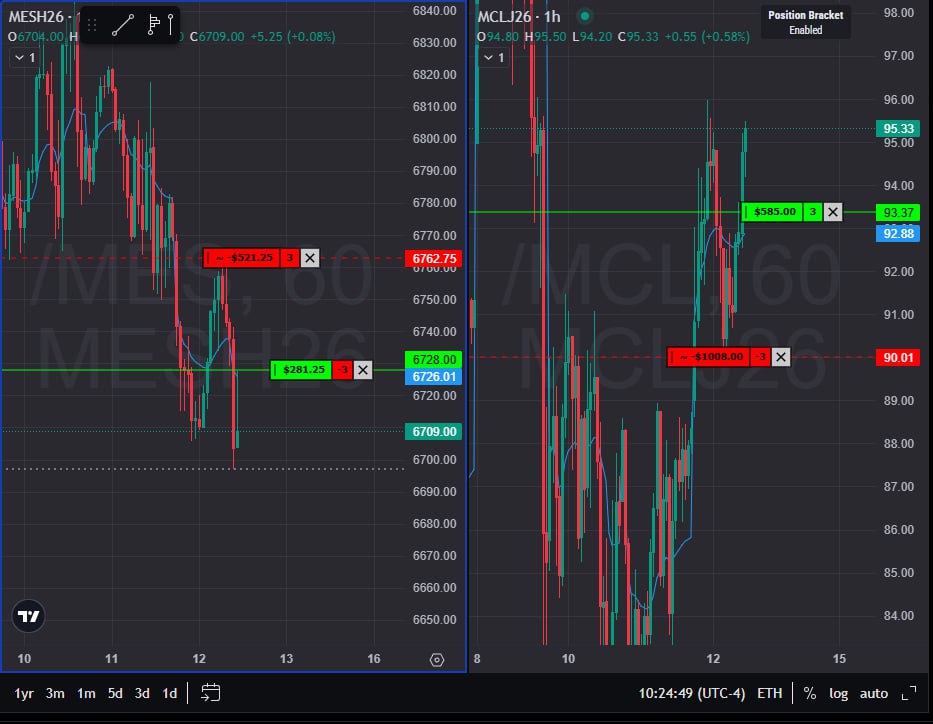
ES short came in around 6,738-6,740 after the 10:00 AM window opened. Both positions moved into profit initially. Oil ran up quickly, and by 10:35 AM I locked it in at +$7. Extended move on oil means take the money—don't let winners turn into losers.
ES looked good for a while, pushing down toward 6,720, but then the 10:30 reversal window hit. Price chopped around, eventually triggering my break-even stop around 4pm. Walked away flat on ES, +$7 on oil.
Then after hours happened. ES pushed straight down to exactly where I'd targeted. Same pattern as Wednesday—institutions hunting retail stops in thin liquidity, then running the real move when most traders are out.
Risk Management
Sizing was disciplined. Challenge mode means maximum 0.5% risk per leg, and I kept both positions light. Oil stop was tight below support at $88.90. ES stop was above 6,750 to avoid the reversal window spike.
The break-even stop on ES wasn't emotional—it was rule-based. When price came back to entry after moving in my favor, the thesis was temporarily invalidated. Rather than hold and hope, I took the exit. No loss is a win in challenge mode.
The frustration is that the thesis was correct. The range expansion happened. The weekly low got tested. I just got stop hunted in the middle of the move.
What Worked / What Didn't
Oil trade worked perfectly. Wyckoff accumulation at weekly support is now a confirmed pattern in my playbook. LPS forming at $88-94, spring higher, lock profits on extended moves. The +$7 gain was significant for oil—don't fight extended moves by hoping for more.
ES thesis was correct but timing was wrong. The after-hours pattern is now two days in a row: quiet NY session, then the real move happens when liquidity thins out. Institutions know where retail stops are, and they're hunting them systematically.
The divergence play worked conceptually—oil recovery with ES weakness did confirm distribution. But executing it in NY hours got me caught in the chop before the real move.
Lessons Learned
Wyckoff accumulation at weekly support is a high-probability setup. When you see LPS forming at a clear support level, especially in a macro-driven asset like oil, the spring pattern tends to work.
After-hours stop hunts are a pattern. Two days in a row now—quiet NY session, then the real move happens at futures open or after hours. If the thesis involves overnight/multi-day moves, consider wider stops or waiting for confirmation after the stop hunt completes.
Lock profits on extended moves. Oil up $7 in a few hours is extended. Don't hope for $10 when $7 is already on the table. Winners that turn into losers destroy psychology.
Break-even stops are valid risk management. Getting stopped at zero isn't failure—it's capital preservation. The thesis can be right while the timing is wrong.
Challenge mode discipline works. Light sizing, tight risk management, and locking profits kept the day positive despite getting stop hunted on ES. No damage to the account, thesis validated for Friday.