null
Trading notes for 2026-01-07
By Sean WeldonTL;DR
After a week-long pullback into discount territory at year-end, the market showed strong bullish momentum with Monday closing at highs. Positioned for continuation with an ES call spread targeting the new year rally in thin liquidity conditions.
Market Context
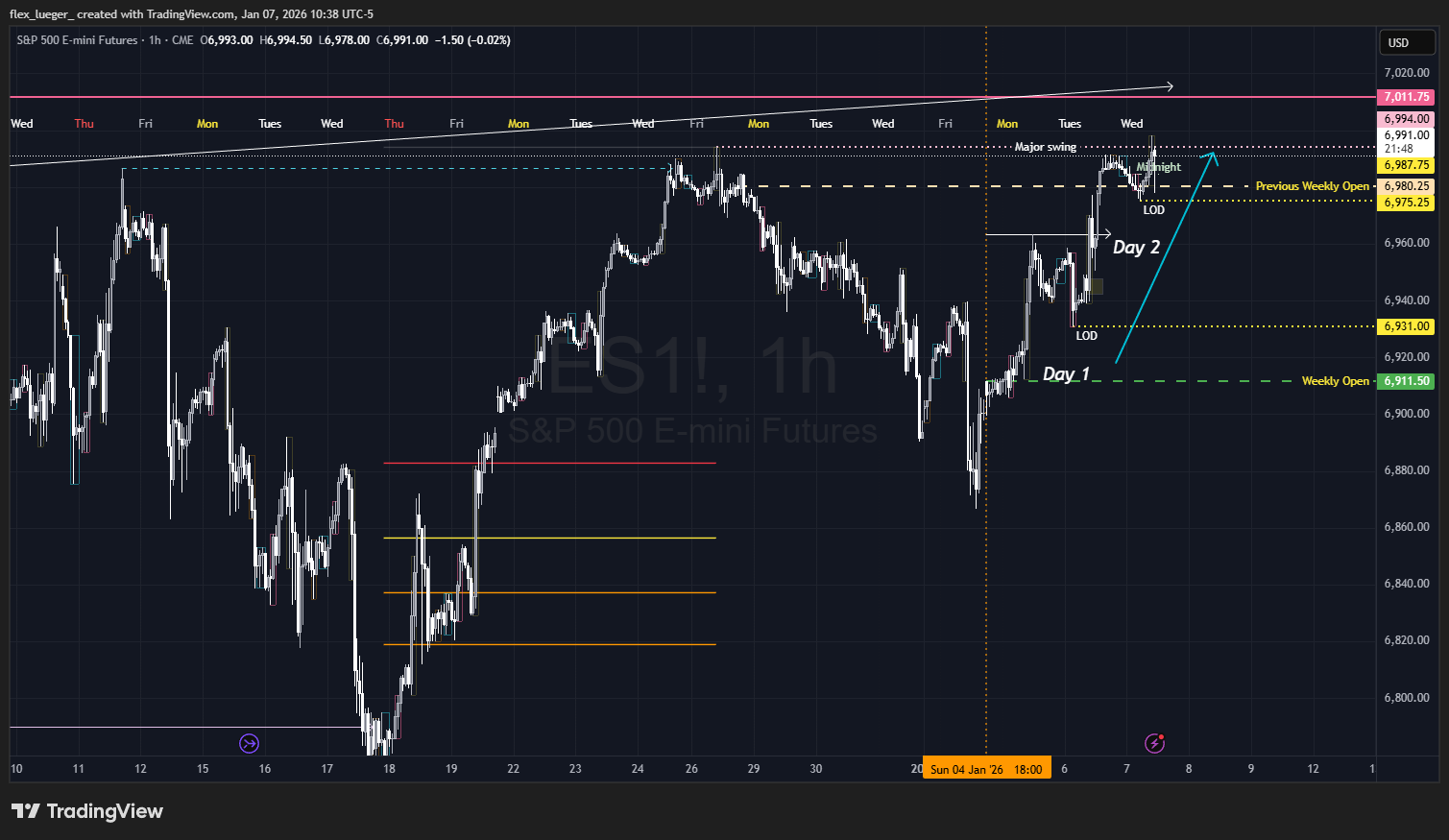
The market experienced a sustained pullback through the end of the year, slowly retracing over an entire week. This decline brought prices from equilibrium down into discount territory before finding support. Following this consolidation period, the market began rallying higher with renewed bullish momentum heading into the new year.
The key technical setup emerged when Monday printed a strong up day, closing right at the session highs. This price action created the foundation for what I identified as a potential multi-day continuation pattern. With thin liquidity typical of early January trading, the conditions were ripe for sustained directional moves.
Thesis & Plan
My thesis centered on a classic day 2 continuation setup following Monday's bullish close at highs. The plan was straightforward:
- Day 1 (Monday): Strong up day closing at highs ✓
- Day 2 (Tuesday): Look for continuation of the bullish momentum
- Day 3 (Wednesday): Potential for extended rally into the open
The setup aligned perfectly with typical new year dynamics where institutional flows and thin liquidity can amplify directional moves. After a week of selling pressure that brought the market into discount levels, the pendulum appeared ready to swing back toward premium territory.
Entries & Exits
I executed the trade using an ES call spread structure rather than outright long calls. This approach provided several advantages:
- Lower capital requirement compared to buying calls outright
- Reduced theta decay through the short leg
- Defined risk parameters with known max loss and profit
The position was structured with 11 days to expiration (DTE), specifically targeting a high-liquidity OPEX expiration date. This timing choice was intentional to ensure tight bid-ask spreads and easy position management.
Risk Management
My options strategy follows a time-based approach depending on market direction expectations:
For bullish positions (like this trade):
- Use 14-21+ DTE to allow time for the move to develop
- Target high-liquidity expiration dates (OPEX) for better fills
For bearish positions:
- Prefer shorter 4-7 DTE since downward moves typically happen faster
- Take advantage of volatility expansion during drops
This asymmetric time allocation reflects the reality that markets tend to fall faster than they rise, with fear driving quicker price movements than greed.
What Worked
The technical setup delivered exactly as anticipated. The market respected the day 2 continuation pattern, with Tuesday following through on Monday's strength. The call spread structure provided good exposure to the upward move while limiting downside risk.
Choosing the OPEX expiration proved beneficial for execution quality, with tight spreads allowing for efficient entry and exit. The 11 DTE timeframe gave adequate runway for the trade to develop without excessive time decay pressure.
Lessons Learned
This trade reinforced several key principles for my future trading:
Timing matters with options selection: The asymmetric approach to DTE based on directional bias continues to prove effective. Bullish trades benefit from more time, while bearish trades can capitalize on faster moves with shorter expirations.
Liquidity is crucial: Sticking to OPEX and other high-volume expiration dates makes a meaningful difference in execution quality, especially when managing multi-leg strategies like spreads.
Seasonal patterns have merit: The combination of year-end positioning unwinding and new year institutional flows created a predictable setup. While not every January will play out identically, understanding these cyclical dynamics provides valuable context.
Technical setups work best with fundamental backdrop: The day 2 continuation pattern was enhanced by the broader context of thin liquidity and seasonal flows. Pure technical analysis becomes more reliable when supported by underlying market structure considerations.
Risk-defined strategies in volatile periods: Using spreads instead of outright long options helped manage risk during a period of uncertain volatility. The defined max loss provided peace of mind while still capturing the directional move.
Going forward, I'll continue focusing on high-probability continuation patterns while maintaining the asymmetric options timing approach. The key is remaining disciplined about entry criteria and not forcing trades when the setup isn't clean.